what to do when family member attempts suicide
Frequently Asked Questions Near Suicide
- Download PDF
- Download ePub
- Society a gratis hardcopy
- En español
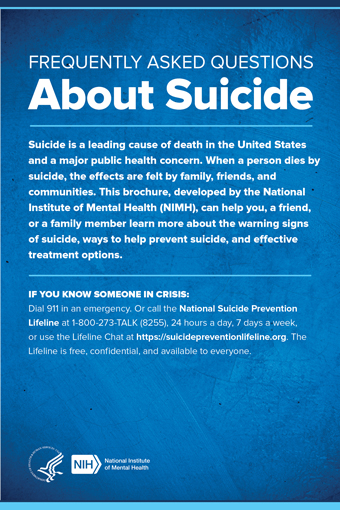
Suicide is a leading cause of expiry in the United States and a major public health concern. When a person dies past suicide, the effects are felt past family, friends, and communities. This brochure, developed by the National Institute of Mental Wellness (NIMH), tin can help you, a friend, or a family member acquire more about the warning signs of suicide, ways to help prevent suicide, and effective handling options.
If you lot know someone in crisis:
Dial 911 in an emergency. Or phone call the National Suicide Prevention Lifeline at i-800-273-TALK (8255), 24 hours a twenty-four hour period, 7 days a week, or use the Lifeline Chat at the Lifeline website. The Lifeline is free, confidential, and bachelor to everyone.
What is suicide?
Suicide is when people impairment themselves with the goal of catastrophe their life, and they die as a issue.
Asuicide attempt is when people harm themselves with the goal of catastrophe their life, but they practice non die.
Avoid using terms such as "committing suicide," "successful suicide," or "failed suicide" when referring to suicide and suicide attempts, equally these terms oftentimes deport negative meanings.
Who is at risk for suicide?
People of all genders, ages, and ethnicities can exist at risk for suicide.
The main take chances factors for suicide are:
- A history of suicide attempts
- Depression, other mental disorders, or substance utilise disorder
- Chronic pain
- Family unit history of a mental disorder or substance use
- Family history of suicide
- Exposure to family violence, including concrete or sexual abuse
- Presence of guns or other firearms in the home
- Having recently been released from prison or jail
- Exposure, either direct or indirectly, to others' suicidal behavior, such as that of family members, peers, or celebrities
Nigh people who have risk factors for suicide will non attempt suicide, and it is hard to tell who volition human activity on suicidal thoughts. Although chance factors for suicide are important to continue in heed, someone who is showingwarning signs of suicide may be at higher risk for danger and need immediate attention.
Stressful life events (such equally the loss of a loved one, legal troubles, or financial difficulties) and interpersonal stressors (such as shame, harassment, bullying, discrimination, or relationship troubles) may contribute to suicide risk, particularly when they occur along with suicide risk factors.
What are the warning signs of suicide?
Warning signs that someone may be at immediate risk for attempting suicide include:
- Talking nigh wanting to die or wanting to impale themselves
- Talking about feeling empty or hopeless or having no reason to alive
- Talking most feeling trapped or feeling that there are no solutions
- Feeling unbearable emotional or physical hurting
- Talking near existence a brunt to others
- Withdrawing from family and friends
- Giving away important possessions
- Proverb good day to friends and family
- Putting affairs in order, such as making a will
- Taking nifty risks that could lead to death, such as driving extremely fast
- Talking or thinking virtually death frequently
Other serious warning signs that someone may exist at risk for attempting suicide include:
- Displaying extreme mood swings, suddenly changing from very sorry to very calm or happy
- Making a plan or looking for ways to kill themselves, such equally searching for lethal methods online, stockpiling pills, or buying a gun
- Talking almost feeling great guilt or shame
- Using alcohol or drugs more oft
- Acting anxious or agitated
- Changing eating or sleeping habits
- Showing rage or talking most seeking revenge
Does request someone about suicide put the idea in their caput?
No. Studies take shown that request people almost suicidal thoughts and behaviors does non crusade or increase such thoughts. Request someone straight, "Are yous thinking of killing yourself?" can be the best style to place someone at risk for suicide.
Do certain groups of people have higher rates of suicide?
According to the Centers for Disease Control and Prevention (CDC), women are more than likely to attempt suicide than men, but men are more probable to die past suicide than women. This may be considering men are more probable to try suicide using very lethal methods, such as firearm or suffocation (e.g., hanging), and women are more probable to attempt suicide past poisoning, including overdosing on prescribed or unprescribed prescription drugs. However, recent CDC information suggest that the leading ways of suicide for women may exist shifting toward more lethal methods.
CDC information as well show that suicide rates vary by race, ethnicity, age, and gender. American Indian and Alaska Native men have the highest rates of suicide, followed by not-Hispanic White males.
Although the rate of suicide death among preteens and younger teens is lower than that of older adolescents and adults, it has increased over time. Suicide now ranks as the second leading cause of expiry for youth ages x to 14. For children under age 12, inquiry indicates that Black children have a college charge per unit of suicide death than White children.
Notation: Subsequently steadily increasing for many years, the overall suicide rate decreased slightly from 2018 to 2019. Y'all can acquire more about this finding on the CDC website. Researchers are examining whether this decrease occurred across different racial, indigenous, gender, and age groups, and whether it volition continue over time.
Looking for more data and statistics? For the most recent statistics on suicide and more data almost suicide risk, please visit the CDC suicide prevention folio and the NIMH suicide statistics page.
Do people 'threaten' suicide to get attention?
Suicidal thoughts or actions are a sign of extreme distress and an indicator that someone needs help. Talking about wanting to die past suicide is not a typical response to stress. All talk of suicide should exist taken seriously and requires immediate attention.
What handling options and therapies are bachelor?
Constructive, evidence-based interventions are available to help people who are at risk for suicide:
- Cognitive Behavioral Therapy (CBT):CBT is a type of psychotherapy that can help people acquire new ways of dealing with stressful experiences. CBT helps people learn to recognize their thought patterns and consider alternative deportment when thoughts of suicide arise.
- Dialectical Behavior Therapy (DBT):DBT is a type of psychotherapy that has been shown to reduce suicidal behavior in adolescents. DBT also has been shown to reduce the rate of suicide attempts in adults with borderline personality disorder, a mental illness characterized by an ongoing design of varying moods, self-paradigm, and behavior that often results in impulsive actions and problems in relationships. A therapist trained in DBT can help a person recognize when their feelings or actions are disruptive or unhealthy and teach the person skills that can help them cope more effectively with upsetting situations.
- Brief Intervention Strategies :Research has shown that creating a condom plan or crunch response plan—with specific instructions for what to do and how to get help when having thoughts about suicide—can aid reduce a person'south risk of acting on suicidal thoughts. Staying continued and following upwards with people who are at chance for suicide also has been shown to assistance lower the risk of futurity suicide attempts. Research besides has shown that increasing safe storage of lethal ways tin help reduce suicide attempts and deaths by suicide. In addition, collaborative cess and direction of suicidality can assist to reduce suicidal thoughts.
- Collaborative Care:Collaborative care is a team-based arroyo to mental health care. A behavioral health care managing director volition work with the person, their principal health care provider, and mental health specialists to develop a handling plan. Collaborative care has been shown to be an effective mode to treat depression and reduce suicidal thoughts.
What should I do if I am in crunch or someone I know is because suicide?
If y'all notice warning signs of suicide—especially a change in beliefs or new, apropos beliefs—get help every bit soon every bit possible.
Family and friends are frequently the first to recognize the warning signs of suicide, and they tin can have the first step toward helping a loved ane find mental health treatment.
If someone tells you that they are going to kill themselves, do non leave them lonely. Exercise not promise that you lot volition proceed their suicidal thoughts a secret—tell a trusted friend, family unit member, or other trusted adult.
Call 911 if there is firsthand danger, or get to the nearest emergency room.
In a crisis, you also can contact:
- National Suicide Prevention Lifeline
Telephone call one-800-273-TALK (8255); En español one-888-628-9454
The Lifeline is a costless, confidential crisis hotline that is available to anybody 24 hours a twenty-four hour period, seven days a week. The Lifeline connects people to the nearest crisis center that provides crisis counseling and mental health referrals.
- Crisis Text Line
Text "HELLO" to 741741
The Crunch Text Line is available 24 hours a day, 7 days a week. This confidential service helps anyone, in any type of crunch, connecting them with a crisis counselor who can provide support and information.
What if I run across suicidal messages on social media?
Knowing how to get help when someone posts suicidal messages can help salve a life. Many social media sites have a process to get help for the person posting the message.
If you see letters or alive streaming content that suggests someone is actively engaging in suicidal behavior, call 911or call the National Suicide Prevention Lifeline at 1‑800‑273‑TALK (8255).
How tin can I discover help?
If you have thoughts of suicide, tell your health care provider. Your health care provider volition mind to your concerns and can help you effigy out next steps. Read NIMH's Tips for Talking With Your Health Care Provider to assist you prepare to talk to your doctor nearly mental health concerns.
To discover mental health treatment services in your expanse, call the Substance Corruption and Mental Health Services Administration (SAMHSA) Treatment Referral Helpline at 1-800-662-Aid (4357) or use the SAMHSA Behavioral Wellness Treatment Services Locator.
Where can I learn about NIMH research on suicide?
NIMH supports promising inquiry that is likely to take an impact on reducing suicide in the United States. Research is helping amend our ability to place people at adventure for suicide and to develop and improve effective treatments. NIMH researchers go along to written report suicide and how to best implement suicide prevention and intervention programs in different settings, including health care, community, school, and the justice system.
Learn more about NIMH research priorities and recent research on suicide prevention.
For additional data about suicide prevention efforts, visit the National Action Alliance for Suicide Prevention and Nil Suicide.
What should I know about clinical trials?
Clinical trials are enquiry studies that look at new means to prevent, detect, or treat diseases and conditions. Although individuals may do good from being part of a clinical trial, participants should be aware that the primary purpose of a clinical trial is to gain new scientific noesis and so that others may be better helped in the future.
Talk to your wellness intendance provider about clinical trials, their benefits and risks, and whether 1 is right for yous. For more data, visit NIMH's clinical trials webpage.
Reprints
This publication is in the public domain and may be reproduced or copied without permission from NIMH. Citation of NIMH every bit a source is appreciated. To acquire more virtually using NIMH publications, please contact the NIMH Information Resources Center at 1-866-615-6464, email nimhinfo@nih.gov, or refer to NIMH'south reprint guidelines.
U.Southward. DEPARTMENT OF Wellness AND Human being SERVICES
National Institutes of Wellness
NIH Publication No. 21-MH-6389
Revised 2021
Source: https://www.nimh.nih.gov/health/publications/suicide-faq
0 Response to "what to do when family member attempts suicide"
Post a Comment