what is a mean state, according to aristotle?
Aristotle'due south Views on State, Man and Regime
- 23 Dec 2021
Introduction
The subject of political scientific discipline has evolved by questioning the nature and importance of concepts similar state, constitution, citizenship, laws, and governments.
Aristotle, famously referred to as the father of political scientific discipline, had laid the bricks of the subject area. In this blog, you lot will read almost his understanding of the land, nomenclature of constitutions and the cycle of governments.
Aristotle: Father of Political Science
The starting time man to distinguish between various branches of noesis had been Aristotle. He differentiated betwixt meteorology, poetics, logic, biology, ethics, natural history, aesthetics, physics, rhetoric, metaphysics and fifty-fifty wrote extensively on these subjects.
He did not merely lay the foundation stone of political science but also contributed significantly to its elaboration as well. "Politics", "Ethics", and "Rhetoric" are few among many of his works that agree discussions on questions of constabulary, equality, justice, etc.
According to Aristotle, political science is a master science. He gives credit to political science as a chief-fine art because, unlike other sciences that serve every bit a ways to an end, political science pertains to the ends of human existence in itself. Aristotle, thus viewed political science as the end to human beingness rather than as a means to it.
In his volume, The Nicomachean Ethics, Aristotle writes, "The supreme proficient... must exist the object of the most authoritative of the sciences - some scientific discipline which is a master craft. But such is manifestly the science of politics, for information technology is this that ordains which of the sciences are to exist in states, and what branches of knowledge the unlike classes of citizens are to learn, and up to what signal."
His view demonstrates that political scientific discipline dominates all other sciences. It explains his "Hierarchy of Ends", implying that each branch of knowledge is simply a ways and would ultimately serve the cease of leading a adept life. Note here that Greek philosophers and their view of politics share 1 mutual notion. They believe that the land comes into existence for the sake of life and continues for the sake of good life. Aristotle doesn't differ on this notion and is hence considered to view the scientific discipline of politics as supreme to other sciences.
Aristotle and his view on Country
Aristotle views the state as natural. Co-ordinate to him, the country is a necessary condition for all humans. Similar Plato, he doesn't differentiate between land or society and, in a like fashion, considers information technology to exist essential for a good life. Thus, in his view, the State is a necessary status of a good life.
Any human beingness cannot survive in isolation, and thus, a man and a woman institute a household. A village is formed when a family unit expands itself, and when many such villages are formed, a state comes into being. Equally and when a state is formed and order is organised, man beings can meet their needs.
It is for the same reason that the state'due south existence is as important and natural as the presence of a family or hamlet. Still, about human associations are flawed and help to fulfil one or a few facets of the good life, merely that's untrue for a country. He viewed the land as being able to meet the whole or all facets of a good life.
It is important to sympathise why he perceived the land as natural for humans. According to him, there is no difference between an creature or a human being, other than the fact that a human being has the desire and a sense of living a expert life. What information technology means is that man beings go different from animals simply if they exist in a country. It is the aforementioned desire to lead a good life that makes the formation of a state a natural thing to occur.
Aristotle and his view on Man
Aristotle believes that Man is a political animal. This analogy is intriguing because it does not only consider man to be a social animal merely also interprets him as a political existence. Aristotle uses the same concept of the expert life to justify his consideration of a man equally a political existence. He asserts that all kinds of living beings happen to exist in groups, and thus, they tin can be understood equally social animals. However, information technology is solely the quality of human beings to aspire for a good and qualitative life.
For human beings, satisfaction doesn't finish at survival; the constant aspiration to atomic number 82 a good life makes them political beings by default. He says, "he who does not live in a state or who does not need a country is either a beast or a god".
State and its relation with Homo
Aristotle is known for his dictum that Country is prior to man. Chronologically, it is a man who appears before the state. Still, since information technology is the state that makes human beings capable of completing their needs and fulfilling the objective of a adept life, the state is given priority over the man.
To sympathise how the land is before homo, O.P Gauba uses the example of whole and role. A leg or a hand is a office of the body, but a leg or a hand without a trunk is useless; an individual without a state is incomplete, and it is the state that makes him whole.
Aristotle draws a relation between organ and organism. Each organ of a living being performs a specific role; each individual performs different responsibilities in society. The trunk consists of unlike organs performing varied functions, and the body ensures harmony in its functioning. Similarly, the state ensures the communion of various individuals, where the segmentation of labour ensures cooperation and harmony in society.
Aristotle and his classification of governments and constitutions
The male parent of the science of politics owes the title to his proper name because he employed empirical enquiry as to his method. Aristotle was troubled past the instability that existed in Greek metropolis-states' governments. He studied over 158 case histories of various city-states by sending his students to prepare case studies of various constitutions. He analysed almost 160 case histories. To be precise, it is believed that he analysed 158 case histories.
The instance history of Athens is an important source to understand his classification of the constitutions. One tin understand this fact based on two factors:
- The number of individuals ruling the state: whether it is 1 person ruling the land, a few individuals or if it is a rule of many.
- The intent of the ruler or rulers: whether the ruler is ruling for his land's involvement (known as a normal course of government), or whether the ruler is looking subsequently his self-interest (known every bit a perverted form of government).
| Aristotle's Classification of Government | ||
| Public Involvement | Selfish Interest | |
| The One | Monarchy | Tyranny |
| The Few | Elite | Oligarchy |
| The Many | Ramble Democracy | Republic |
(Source: politicalsciencereview.com)
- If it is the rule of ONE, and then it would be MONARCHY or a Kingship in an ideal form of government, or it would exist despotism or TYRANNY in a perverted form.
- If the dominion is by FEW, it would be Aristocracy in an ideal form of government or OLIGARCHY in a perverted form.
- If the rule is past MANY, it would exist POLITY or a constitutional government equally the ideal form of government, and interestingly, Democracy in a perverted form.
According to Aristotle, without whatsoever adequate checks on a ruler'south power, no form of regime would be stable. He believes that ability and virtue cannot coexist.
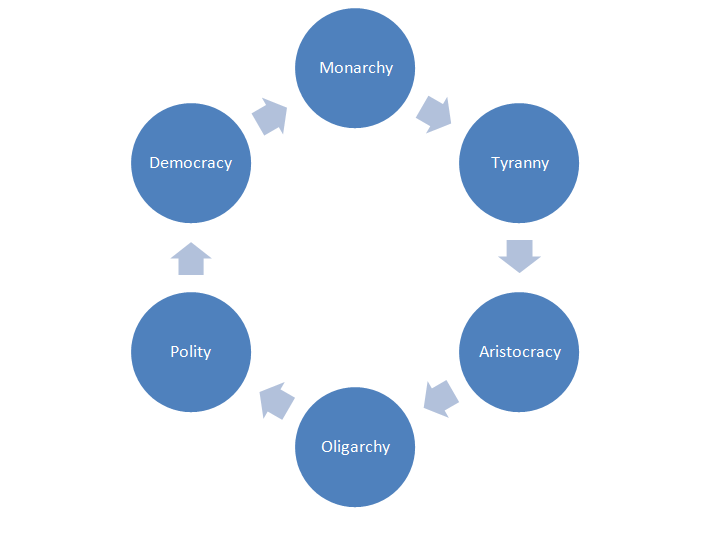
He has provided the cycle of alter of governments over time. Kingship, a normal form of regime, turns to tyranny when there is an absenteeism of control over the monarch's power. Tyranny leads to a rebellion or a revolution by a few individuals who found an aristocracy. Aristocracy tin can deteriorate and turn into an oligarchy, the perverted form. With fourth dimension, a greater many rebels confronting oligarchy and supersede it with polity. Polity further decays in democracy when the many rulers begin to seek their self-involvement. In the end, a single individual who seems virtuous establishes a monarchy, and the progression of platonic class and perverted form continues in a circular motion.
| Monarchy > | Tyranny > | Elite > | Oligarchy > | Polity > | Republic > |
| normal | perverted | normal | perverted | normal | perverted |
 Conclusion
Aristotle gave the concept of a mixed constitution equally a solution to foreclose instability and found a lasting form of government in the Greek urban center-state. He employed his thought of the "Gilt Mean" to create stability. In his volume "Ethics", he explains the Golden Mean as a middle path, which means that virtue lies betwixt two extremes. Anything on an extreme end becomes a vice, and each virtue lies in the centre of the two extremes. For instance, courage is a virtue that lies between the ii extremes of timidity and negligence.
His solution to bring a stable form of government is the combination of rule by few and rule by many. He discarded Monarchy because it would exist corrupt from absolute power. Aristocracy would suit because few would make the rules. This would contain the chosen minority who are educated and rich. However, in case of no checks on aristocracy, it would deteriorate. To forestall that, Aristotle suggests that the decisions made past the aristocracy should exist ratified by the ordinary many. He says that "the people, though individually they may be worse judges than those who take special knowledge, are collectively equally good".
Aristotle's suggestion of a judicious mixture between aristocracy and what is sometimes referred to as Polity or, at other times Democracy, embodies his belief in the Golden Hateful formula. Hence, the competent, rich and educated would rule, but the ordinary citizens would check the elite from exceeding their ability past ratifying their decisions. In modern times, Aristotle's formula is arguably referred to as Constitutional Democracy.

Annie Pruthi
Annie Pruthi is currently pursuing her masters in Political Science from JMI, New Delhi and is a first partitioning Arts graduate from Delhi University. She is an avid reader and an laurels-winning best-selling author. Her book "Will Yous Stay?" recently won the title of "Well-nigh Promising Book, 2020 (Fiction)" in the Coimbatore Literary Awards.