Purpose of Islamic Art on Walls According to Metaphysics
Religious fine art, meanwhile, includes items of religious significance or those used for religious purposes. Non all religious art is Islamic art, while much of Islamic fine art is religious art—even if not plainly and then. Syrian wood inlay cabinets and tables may be used to hold booze, but their geometric patterns portray some of the loftiest realities of Islamic metaphysics and cosmology. Posters of Mecca and Medina or mass-produced prayer carpets emblazoned with the Kaaba are religious art but not Islamic art, despite the sacred compages of the sites they depict. The recitation of the Qur'an in traditional maqāms and fifty-fifty the singing of inspired poetry in these modes and rhythms are both Islamic and religious art, whereas "Islamic" parodies of Justin Bieber songs and the popular auto-tuned, acapella qa śī dahs in 4-function harmony may be religious, only Islamic or sacred they certainly are not.
While difficult to ascertain in concrete, formal terms, Islamic art is recognized easily, especially by those familiar with other dimensions of the Islamic tradition. Whether visual or sonoral, the Islamic arts projection unity (taw ĥ īd), which manifests every bit symmetry, harmony, and rhythm—the banner of unity on multiplicity. The Islamic arts do not mimic or imitate the outward forms of things but present their inner, archetypal realities, hence the emphasis on number (geometry) and messages (calligraphy), which are the bones building blocks of infinite/fourth dimension and language. In traditional calligraphy, geometric ratios govern even the shapes and sizes of the letters, which gives the lettering fine art its remarkable harmony.
The Islamic arts besides all bear the banner of the Qur'an in terms of its meanings (ma¢ānī) and structures (mabānī). Like many sacred texts, many of the surahs and verses of the Qur'an have a chiastic, or ring, structure. That is, the final department mirrors the first, the penultimate department mirrors the second, and and so on, until the middle, which contains the main theme or message. This symmetric, polycentric structure of overlapping patterns is clearly reflected in the geometric patterns of illumination that adorn Qur'anic manuscripts; the tessellations that adorn the mosques, madrasas, and homes where its verses are chanted; and fifty-fifty the construction of the musical maqāms in which it is recited.
Islamic art is founded on the interconnected sacred sciences of mathematics, geometry, music, and cosmology, not so different from the medieval Christian notion of ars since scientia nihil est (art without science is nothing). All of these sciences connect the multiplicity of creation to the unity of the Creator and engage the qualitative, symbolic aspects of multiplicity as well as its quantitative dimensions. Aristotle divided philosophy into 3 parts: physics, mathematics, and theology (ilāhiyyāt). Physics addresses the natural or material earth, and theology the divine, while mathematics (and the associated sciences of geometry and music, which are numbers in space and fourth dimension, in the visual and sonoral domains, respectively) deals with the intermediate, archetypal, imaginal realm—the barzakh, between the divine and the terrestrial. These sciences of the intermediate realm permit the Islamic arts to serve as a ladder from the terrestrial to the celestial, from the sensory to the spiritual. They also have their foundation in Islamic metaphysics and spirituality, which give the artists direct access to the spiritual realities and truths represented in their art.
Plato describes beauty as the splendor of the truthful; the inability to discern betwixt dazzler and ugliness, therefore, corresponds to and accompanies the inability to discern between the true and the fake (al-bā ţ il). Harmonious and geometric, true beauty is timeless and reflects the dazzler of the unseen, leading to quiet and the remembrance of God. False beauty, like ugliness, is fleeting, discordant, and unbalanced, reflecting the chaos and multiplicity of the lower world and the lower levels of the man psyche, which leads to imbalance, dispersion, and heedlessness (ghaflah). It brings out the opaque attribute of creation that hides or veils the divine, whereas true beauty brings out the transparent or reflective aspect of things that makes them legible every bit signs of God.
The 2 Streams of Islamic Art
Dazzler is found in 2 things: in a verse, and in a tent of skin.
– Emir ¢Abd al-Qādir al-Jazā'irī
While the Islamic arts are many and diverse, they can be roughly categorized into ii domains: adab and ambience—that is, the arts of language and those that create the environment in which people live (such equally dress, architecture, urban design, and perfume). In precolonial times, both of these domains were near ubiquitous; they were part of the education of not only Islamic scholars but all Muslims. Nigh all scholars studied, quoted, and wrote poetry. Many were masters of geometry; some were architects; while others, such as al-Fārābī and Amīr Khusrow, were master musicians. Fifty-fifty those scholars who were not accomplished artists were nurtured by the arts of adab, which they studied, and the arts of ambience that marked the institutions of their education. Some of the finest masterpieces of Islamic compages are madrasas, such as the Bou Inania of Fes and Ulugh Beg in Samarqand, because it was understood that architecture can support and nourish the soul, kindle the intellect, and nurture all the other Islamic sciences. Moreover, the arts of adab and ambience were not limited to mosques, madrasas, and palaces but determined the construction and form of the cities and homes in which Muslims lived, not to mention the utensils and tools they used; the apparel they wore; and the melodies, poetry, and idioms that filled their hearts and flowed from their tongues. As Ananda Coomaraswamy notes, in traditional societies, "the artist was non a special kind of homo, but every man a special kind of creative person."
"Adab" is a word that is notoriously hard to translate into English language. Meaning at once "custom, civilization, etiquette, morals, courtesy, decorum, and civilized comportment, as well equally literature," to accept adab is to exist well-read and educated, to have skillful manners, to be cultured or refined, and to have the wisdom to give everything and everyone their due rights. The literature of adab is then named because it is designed to cultivate adab in its readers. Studying Islamic literature in the traditional fashion shapes and refines one's soul, intelligence, beliefs, and speech according to the prophetic norm of elegance and eloquence.
The Prophet'due south married woman ¢Ā'ishah called the Prophet ﷺ "the Qur'an walking on earth," and the arts of adab nurture the creation of such character. Virtually all works of Islamic literature are, in one way or some other, commentaries on the Qur'an. Even the profane poesy of Abū Nuwās or al-Mutanabbī bears the banner of the revelation in its language, images, idioms, and rhythms. The sophisticated belles-lettres of al-Jāĥiż, al-Ĥarīrī, Niżāmī, and Sa¢dī sharpen not simply the linguistic but also the intellectual and moral faculties of their readers. The philosophical allegories of the Brethren of Purity, Ibn Sīnā, Suhrawardī, and Ibn Ţufayl describe on Qur'anic narratives and concepts, while integrating and inspiring the imagination and the intellect.
The influence of the Qur'an is fifty-fifty more axiomatic in the more sacred works of adab, such as Jalāl al-Dīn Rūmī'south Mathnawī; ¢Aţţār'southward Homo ţ iq al- ţ ayr; Ibn ¢Aţā' Allāh's Ĥ ikam; and the poetry of al-Būśīrī, Hafez, Ibn al-Fāriđ, Yūnus Emre, Amīr Khusrow, Ĥamzah Fansūrī, Shaykh Aĥmadu Bambā, Shaykh Ibrāhīm Niasse, and many others whose meanings, structures, styles, and even sounds closely mirror those of the Qur'an.13 These works of adab are like lagoons that open onto the ocean of the Qur'an, which in turn opens onto the divine reality. Works of adab bring us closer to the Qur'an and bring the Qur'an closer to the states: they train us to read and interpret verses that take multiple levels of meaning, to read verses and stories from multiple perspectives, and to dive into their depths for pearls of significant; they teach united states how to read and live the Qur'an and Sunnah. In short, they cultivate adab.
Throughout Islamic history, most Muslims learned metaphysics, cosmology, and ethics through these poems and works of literature. To paraphrase a South Asian Muslim nawab'southward complaining: "We lost our culture and the living reality of our organized religion when we stopped studying the Gulest ā n of Sa¢dī." Our grandmothers and grandfathers and the quondam generations of Muslims learned how to realize, live, and put into practice the Qur'an and Sunnah, in large part, through the poems and works of the literature they memorized and studied, even if they could not read or write. The words of the 8th-century (2nd-century hijr ī) scholar and mu ĥ addith Ibn al-Mubārak seem even more true today: "We are more than in need of acquiring adab (courtesy) than of learning hadith."
The traditional madrasa combines the learning of adab with the cute arts of ambient. Whether in the elaborate and ornate tessellation of the Ben Youssef madrasa of Marrakesh or under the uncomplicated shade of a baobab tree in the Sahel, surrounded past God's artwork of nature, Islamic learning traditionally takes place in a beautiful ambient. This is pregnant and intentional, every bit one's surroundings have a profound impact on i's thoughts. Contemplating the twin rosettes/stars on a Moroccan door helped me grasp the human relationship between the divine essence and names, and their manifestations in the creation and the human soul, and it was while gazing at the tiles in the Bou Inania madrasa in Fes that I realized the meaning of the metaphor describing God as "a circle whose eye is everywhere and whose circumference is nowhere."
The nigh ubiquitous and important art that creates an Islamic ambience is the recitation of the Qur'an. This is the first and highest course of Islamic fine art, from which all others are derived. The precise art of tajwīd and the scientific discipline of the maqāms, the musical modes in which the Qur'an is recited, bring out the beauty and geometry of the Qur'anic revelation as information technology was revealed to the Prophet ﷺ. In reciting the Qur'an, we participate in the divine act of revelation and the prophetic act of reception, both of which have a greatly transformative outcome on our souls. The sound of Qur'anic recitation is an integral office of the soundscape of any Islamic metropolis or town and is nearly always arrestingly beautiful. This is significant because in traditional Islamic civilisation, truth (of which the Qur'an is the highest case) is always accompanied by dazzler. In fact, beauty is a criterion of the authentically Islamic. There is nothing Islamic that is non cute. This precept governs every other traditional art of ambience, such as calligraphy; compages and geometric pattern; music; and fifty-fifty wearing apparel, food, and perfume. As music plays such a prominent role in contemporary Western culture, information technology is important to examine music every bit an Islamic art more closely.
Many who know little about music or Islam confidently proclaim that "there is no such matter as Islamic music" due to the lack of consensus near the condition of music in Islamic law. Starting time, it is important to distinguish the English term music from the Arabic mūsīqā. Although both are derived from the same Greek discussion meaning "the art of the muses," they have slightly dissimilar meanings and connotations. Whereas a native English speaker would classify the religious chanting of poesy, prayers, the adhān, or the Qur'an as music or musical, these arts would non be considered mūsīqā, which has the connotation of involving instruments and beingness non-religious. Similarly, the instrumental and song music (in the English sense) that accompanies some Sufi ceremonies is seldom considered mūsīqā; rather, it is called samā¢(audience) or dhikr (remembrance).
Nevertheless, instrumental music, whether mūsīqā or samā¢, remains controversial in the Islamic legal traditions precisely because of its tremendous power to elevate or debase the soul. Simply compare the behavior of an audience at a heavy metallic concert with that at a concert of Andalusian music. When criminals or soldiers pump themselves upwardly to commit acts of violence, they seldom listen to the Indian classical music of Ali Akbar Khan. Traditional Islamic music has a remarkable power to induce states of remembrance, peace, contentment, joy, courage, harmony, balance, and most especially love and longing for the divine. The Islamic philosophers developed elaborate musical theories based on the principles of Pythagorean harmony to explicate and refine preexisting folk traditions of music. Court musicians produced a refined and refining art that served as the acoustic equivalent and accompaniment of adab, while the Sufi orders adult powerful traditions of spiritual music capable of transporting the soul into the divine presence. Although Islamic music differs widely from culture to culture, it has certain common features related to its Islamic cosmology and emphasis on taw ĥ īd. It typically has a regular rhythm (rhythm is the imprint of oneness across time), oftentimes increasing in pace toward the cease of the vocal or concert, before dropping off into silence (which mirrors the acceleration of fourth dimension as the final hour approaches); information technology ofttimes includes ś alawāt or Qur'anic recitation; and it is characterized by a unity of melodic voices, eschewing the complex harmonies and multiple voices that characterize the best of Western music (e.thousand., Bach), due to its emphasis on taw ĥ īd. For the skilled musician in an Islamic tradition, playing music is like praying with one's instrument, and for the prepared listener, it is like listening to the wordless praise of the angels and the cosmos. As Seyyed Hossein Nasr notes, "Islamic civilization has not preserved and adult several great musical traditions in spite of Islam, simply because of it."14
Information technology is important to note that music and other traditional Islamic arts not just belong to the past only are contemporary living traditions. All of these art forms are dynamic: they continually change, adapt, and create new possibilities, all without departing from the fundamental principles of their particular class, the very principles that brand them Islamic. These same principles can be practical to new art forms, such as web and graphic design, photography, and cinematography. The cinematic arts are primarily derived from the theater, which was never a major Islamic fine art, as it was in the ancient Greek, Christian, and Hindu civilizations. In fact, Greek works of drama and theater were just about the only works Muslims did not translate into Arabic, perhaps considering the Islamic revelation is based more on a presentation of "the manner things are" and not on the heroic sacrifice of a God-man (Christianity) or on the myths well-nigh personified aspects of the divine (ancient Greek and Hindu traditions) that are repeated in liturgy and passion plays. The relatively non-mythological graphic symbol of the Islamic tradition, and its emphasis on the unity and omnipotence of the divine, precluded dramatic tension within the divine or between human heroes and the divine. However, Persian Shi¢ism developed the drama of ta¢ziyeh depicting the events of the battle of Karbala, and while not a central sacred fine art, it was nevertheless an important Islamic religious art course. This is probably not unrelated to the fact that Iran has the almost adult cinematic tradition of any Muslim land. Although some of Majid Majidi'due south films come up close, I believe a truly Islamic cinematic art has yet to develop. Islamic movie theatre is not merely movies about Islam or Muslims, or cinema fabricated by Muslims, but the very philosophy and techniques of the art must be rooted in the Islamic perspective, much as Bresson's work is rooted in Catholicism, Terrence Malik'due south piece of work is rooted in a Heideggerian philosophy, and Tarkovsky's work is rooted in his ain unique metaphysical vision influenced by Russian Orthodox Christianity.15
All of the Islamic arts be to support the supreme art: the purification of the soul, the tillage of graphic symbol, and the remembrance of God. "I was sent only to perfect the beauty of character," the Prophet ﷺ said. There is no question of "art for art'south sake" in the Islamic arts considering all of them have practical, psychological, and spiritual functions. The Islamic arts are non a luxury; rather, they serve as essential supports for that art which is the raison d'être of Islamic law, theology, and indeed the unabridged Islamic tradition—the realization of the full potential of the human state (and thus the entire cosmos, through humanity's part every bit khalīfah) through the remembrance of God. The neglect of the Islamic arts has severely crippled the ummah's power to pursue this highest fine art, both individually and collectively.
Tin Fine art Heal Our Souls?
Know, O blood brother ... that the written report of sensible geometry leads to skill in all the practical arts, while the report of intelligible geometry leads to skill in the intellectual arts because this science is one of the gates through which we move to knowledge of essence of the soul, and that is the root of all knowledge.xvi
– Ikhwān al-Śafā
Dazzler will save the world.
– Fyodor Dostoevsky
Equally these epigrams suggest, the Islamic arts are gates through which we tin admission the deepest truths of the cosmos, the revelation, and ourselves. The fail of these arts is a terrible accident, non only to our aesthetics but also to our ethical, intellectual, and spiritual lives. Just equally our bodies, in a sense, go what we eat, our souls go what nosotros await at, listen to, read, and recall virtually. When the Islamic arts are rare, unrecognized, and underappreciated, what and then happens to our souls?
But every bit our bodies, in a sense, go what we swallow, our souls go what we look at, listen to, read, and think about. When the Islamic arts are rare, unrecognized, and underappreciated, what so happens to our souls?
The loss of the Islamic arts is also securely connected with the rising of extreme sectarianism, the atrophy of the imaginal kinesthesia, and the overall difficulty perceiving unity in diverseness. In traditional Islamic cosmology and metaphysics, multiplicity and difference govern the outward world of appearances, whereas unity increases the farther one travels inwards, into the world of meaning and spirit. Because God is i, every bit one approaches the divine presence, things become more unified. Those without access to this unity are unable to perceive and participate in the harmony—the reflection of unity in multiplicity—that links the world of appearances to that of realities. Imagination and the arts are bridges that unite these two worlds.
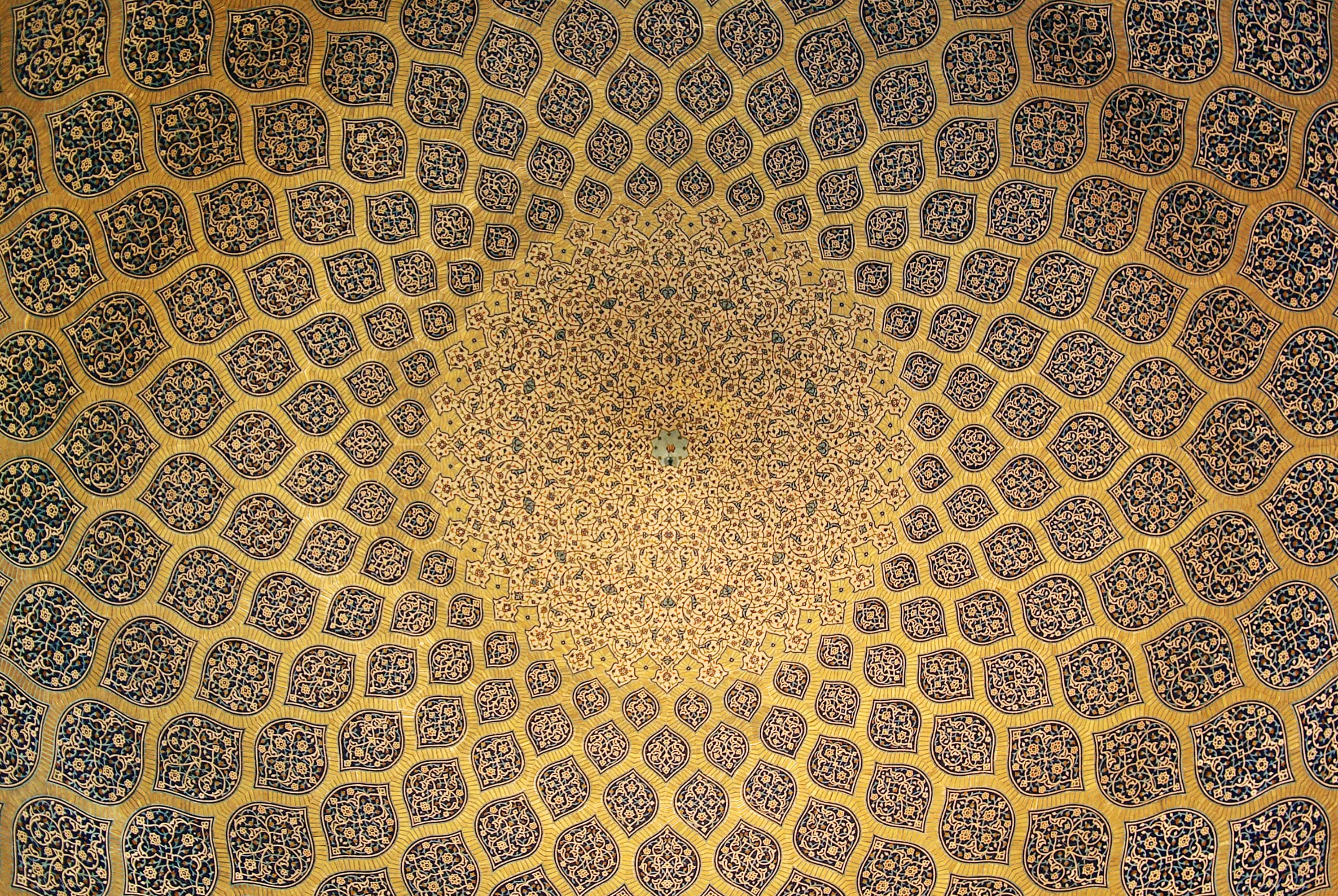
Dome interior of Shaykh Lutfollah Mosque
Those with a deep appreciation of the Islamic arts can appreciate thebarakah of and identify the profound realities represented in the architecture of Almohad Morocco, Mamluk Egypt, or Safavid Islamic republic of iran completely irrespective of the official legal school or theology of these dynasties. Moreover, those familiar with the profound principles of Islamic art cannot assistance but notice these same principles, admitting in a unlike mode, in the sacred arts of the other revealed religions. Islamic art, like Islam itself, synthesizes and confirms the traditions of sacred arts that came before it.17 Anyone familiar with the theory and principles of Islamic music cannot aid merely admire Bach, and those adept inadabwill find much to appreciate in the works of Shakespeare and Chuang Tzu, despite the great differences in the manner the Muslim composer and these authors applied universal principles. In addition, anyone familiar with Islamic sacred geometry cannot neglect to recognize the same principles at work in Buddhist and Hindu mandalas and temples.
This is precisely what Muslim scholars and artists have done for generations: understood, appreciated, and integrated the arts and sciences of other civilizations. One of the clearest signs of our decline has been the virtual disappearance of these constructed and creative intellectual and artistic processes. This has also been accompanied by increasing tensions between different Muslim groups and minority communities of other faiths that thrived in Muslim-bulk lands for centuries. The Qur'an describes the diversity of humanity as providential and divinely willed in lodge for us to know one some other, and through this knowledge, to better know ourselves and our God.xviii As Muslims lose touch with knowledge of our arts, of our history, of ourselves, of our tradition, and of God, we lose touch with reality and with the ability to recognize the truth and humanity of those who differ from usa.nineteen
For Muslims who practice a craft, such every bit the Islamic arts of calligraphy, poetry, or Qur'anic recitation, that craft provides them with a model for Islamic spirituality. A arts and crafts is an activity that requires continuous practice and comeback over a lifetime, non a cookie-cutter mold into which i either fits or does non. If we view the purification of our hearts, the try to follow in the Prophet'south footsteps, and the quest to know God as a craft or an fine art form instead of as an identity, we can understand how different approaches can pb to the same or a like goal. Thus, I believe the recent epidemic oftakfīr could be ameliorated by agreement the practice of Islam every bit an art form instead of focusing on an either/or notion of Muslim identity.
All is non lost, however. Discernment, whether intellectual or artful, is difficult to recover once lost, merely the Qur'an says, "Inquire the people ofdhikr, if you do not know" (21:07). Those Islamic societies and communities with thriving traditions of Islamic spirituality tend to have thriving artistic traditions, even if they are not economically wealthy (every bit in W Africa). This is because the practice of Islamic spirituality, being the science of taste (dhawq), refines one's taste, enabling recognition of spiritual truths and realities (ĥaqā'iq) in sensible forms; similarly, the Islamic arts support and refine the practice of Islamic spirituality. The revival of the arts must exist a priority for Muslims worldwide because the arts are vital to the rejuvenation of the Muslim mind and soul.xx As Plato wrote, "The arts shall treat the bodies and souls of your people." While many have attempted to reduce the Islamic tradition to a list of dos and don'ts in the realm of beliefs and conventionalities, the Islamic arts serve as a powerful reminder of the more profound realities of the tradition, ofiĥsān, and of the purpose of the entire Islamic tradition in the first place: the highest art of bringing the human soul back to itsfiţrah, which perfectly reflects all of the divine names and qualities, both thejalāl (the regal) and thejamāl (the beautiful).
Source: https://renovatio.zaytuna.edu/article/the-silent-theology-of-islamic-art
0 Response to "Purpose of Islamic Art on Walls According to Metaphysics"
Post a Comment